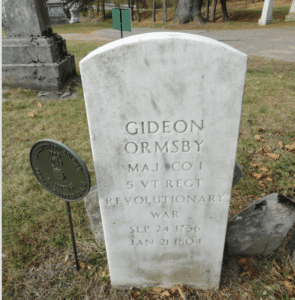
Gideon Ormsby (1736–1804) was a prominent early settler, Revolutionary patriot, and political leader in Manchester, Vermont. His legacy is memorialized on his gravestone in Dellwood Cemetery, which reads: “Thus departed a Supporter of our Federal Constitution, and a friend of the Right,” accompanied by a DAR marker recognizing his service as a Revolutionary soldier.
Ormsby’s family journey reflects the broader westward movement of colonial New Englanders. His father, Jonathan Ormsby, moved the family from Rehoboth, Massachusetts, to Rhode Island, then to Amenia (Great Nine Partners), New York, before helping purchase and survey 23,000 acres in what would become Vermont in the 1760s. By about 1767, the family settled in Manchester, where Gideon raised his family and became deeply involved in the region’s development.
During the turbulent years leading up to the American Revolution, Vermont—then known as the New Hampshire Grants—was marked by fierce conflict between Loyalists (“Tories”) and independence-minded settlers (“Whigs”). Gideon Ormsby and his family were firmly Whigs. He served on Manchester’s Committee of Safety in 1777, participated in the Dorset and Windsor Conventions, and was present when Vermont declared itself a free and independent state. He later served as one of Vermont’s first state legislators in 1778 and again in 1802.
Ormsby’s loyalty to the Patriot cause made him a target. In a dramatic episode around 1777, Tories abducted his son Daniel and carried him into the forests of Rupert. Daniel cleverly marked his trail, allowing a rescue party to track and save him just in time. Another Ormsby child, Mary, became locally celebrated for bravely warning her father of Tory activity—an act later honored when the Mary Ormsby Chapter of the Daughters of the American Revolution was named for her.
Artifacts connected to Ormsby, including a Revolutionary-era fowler musket made in Connecticut between 1777 and 1779, further anchor his story in the material culture of the time.
Today, Gideon Ormsby is remembered as a steadfast patriot whose life captures the dangers, ideals, and determination that shaped early Vermont during the American Revolution.
For more information see Genealogy Website – Gideon Ormsby
Gideon Ormsby’s gravesite is in Dellwood Cemetery – Find a Gravesite – Dellwood Cemetery
How did Ormsby Hill get its name
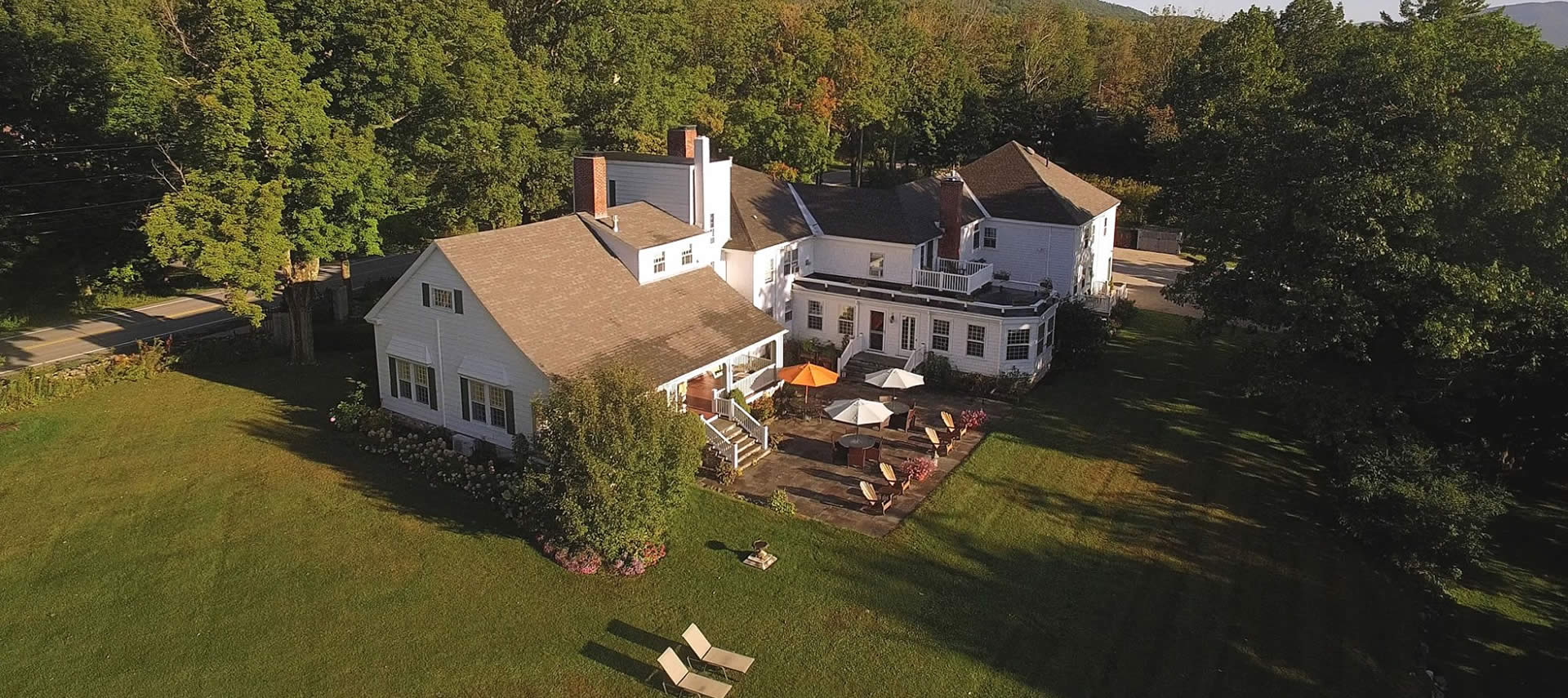
Gideon Ormsby was a prominent early settler, Revolutionary patriot,
Ormsby Hill in Manchester, Vermont wasn’t formally named at a specific documented moment like some official geographic designation. Instead, the name evolved over time from local usage tied to one of Manchester’s earliest and most prominent settlers, Major Gideon Ormsby. Early settlers laid out the town’s roads in the 1760s, and the long slope rising from the flats came to be known locally as Ormsby Hill (as well as Purdy Hill after another early owner) because Gideon Ormsby’s farm was located partway up the hill and he was a leading figure in the community. This informal naming likely took shape during the late 18th or early 19th century as the settlement grew and residents referred to the area by the names of its well-known residents and landowners.
Later, in the 1880s and 1890s, the name was reinforced when the prominent Chicago lawyer Edward Swift Isham purchased the property and developed a large summer estate there, officially calling it Ormsby Hill and linking the historic place name with the substantial estate that became a local landmark.
In short: the hill’s name emerged organically from its association with Gideon Ormsby and was solidified by later usage in the 19th century, especially after Isham’s estate adopted the historic name.