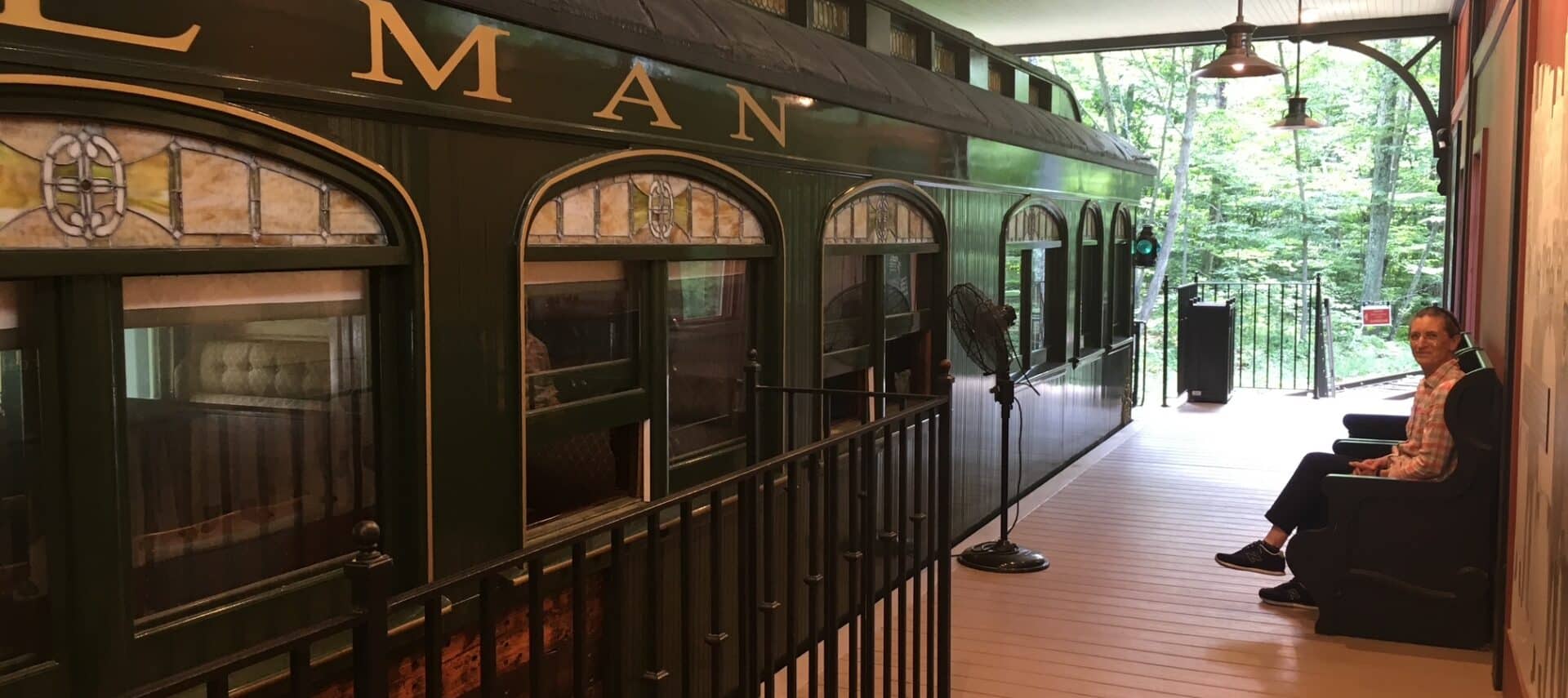
The following is inspired by “Sunbeam” the restored Pullman car displayed at “Hildene, the Lincoln Family Home” in Manchester Vermont.
The Pullman car was significant because it transformed rail travel from an uncomfortable necessity into a practical and comfortable long-distance experience. By introducing sleeping berths, electric lighting, heating, and later air conditioning, Pullman cars set new technological standards for passenger rail design. Their hotel-like interiors reshaped expectations for comfort and luxury in transportation, influencing the design of modern trains and other forms of travel. Beyond technology and design, Pullman cars had a lasting social and economic impact by reshaping railroad business models and playing a major role in U.S. labor history through the Pullman Strike and the organization of Pullman porters. Overall, the Pullman car helped define modern passenger travel and left a lasting legacy in transportation, design, and society.
The Inn at Ormsby Hill shares in this heritage with Edward Swift Isham and Robert Todd Lincoln. Isham owned the property which he named Ormsby Hill. An influential Chicago attorney who founded the prominent law firm Isham, Lincoln and Beale which had a specialty in representing the railroad industry. Robert Todd Lincoln, his partner, later became President of the Pullman Company (1897–1911.)
Isham’s partner, Robert Todd Lincoln built the property today known as “Hildene the Lincoln Family Home” which borders the Inn at Ormsby Hill.
In addition, the Inn at Ormsby Hill displays the same china pattern “Indian Tree” that was used in the Pullman cars – both on display in the dinning room at the inn and at Hildene.
A timeline of the Pullman cars follows:
- Early Railcar Design (1830s–1850s)
- Passenger cars were based on stagecoach designs.
- Wooden bodies, poor suspension, coal or oil lighting.
- No dedicated sleeping spaces; passengers slept sitting upright.
- Unsafe coupling systems and minimal climate control.
Key limitation: rail travel was noisy, unstable, and uncomfortable for long distances.
- Pullman’s First Innovations
1857 – The Pioneer
- George M. Pullman converts an existing railcar into a luxury sleeping car.
- Fold-down berths that transformed seating into beds.
- Thicker upholstery and carpeting to reduce vibration.
- Improved ventilation systems using roof vents.
- Decorative interior finishes inspired by hotels and steamships.
Design shift: railcars become mobile living spaces, not just transport.
- Standardization and Modular Design (1860s–1870s)
- Pullman introduces standard car dimensions, allowing use on multiple railroads.
- Modular interiors: berths, partitions, and fixtures could be repaired or replaced easily.
- Introduction of steam heating from the locomotive.
- Use of gas lighting with centralized control.
- Improved suspension using elliptical springs.
Impact: safer, quieter, and more reliable long-distance travel.
- Material and Structural Advances (1880s–1890s)
- Transition from entirely wooden frames to steel-reinforced construction.
- Fire-resistant materials introduced after deadly rail fires.
- Vestibules added between cars, allowing safe movement while trains were in motion.
- Double-pane windows for insulation and noise reduction.
Engineering focus: durability, passenger safety, and comfort.
- Specialized Car Designs (1890s–1910s)
Pullman develops purpose-built car types:
- Sleeping Cars – private sections with curtains or sliding doors.
- Dining Cars – onboard kitchens, iceboxes, and later electric refrigeration.
- Parlor Cars – luxury seating for daytime travel.
- Observation Cars – rounded or open rear platforms with panoramic windows.
Design philosophy: function-specific interiors optimized for passenger experience.
- Electrical and Climate Innovations (1900s–1920s)
- Transition from gas to electric lighting powered by axle-driven generators.
- Introduction of electric fans and later early air-cooling systems.
- Improved plumbing systems with onboard water tanks and flushing toilets.
- Better soundproofing using layered walls and ceilings.
Result: Pullman cars begin to resemble modern hotel rooms.
- Artistry and Luxury Design (1920s–1930s)
- Interiors reflect Art Deco and Art Nouveau styles.
- Use of exotic woods, brass fixtures, etched glass, and custom textiles.
- Named cars and themed interiors (e.g., regional or natural motifs).
- Private compartments and en-suite washrooms appear in higher-end models.
Peak design era: elegance meets industrial precision.
- Lightweight and Streamlined Cars (1930s–1940s)
- Introduction of lightweight alloy and all-steel construction.
- Streamlined exteriors reduce air resistance and improve efficiency.
- Centralized HVAC systems replace earlier ventilation methods.
- Improved shock absorption and wheel assemblies for smoother rides.
Engineering goal: faster, quieter, more fuel-efficient trains.
- Postwar Modernization and Decline (1940s–1960s)
- Further advances in:
- Air conditioning
- Sound insulation
- Compact private rooms (roomettes, bedrooms)
- Competition from airplanes and cars limits further development.
- High maintenance costs slow innovation.
- Legacy in Modern Rail Design
- Pullman design principles influence Amtrak sleeper cars.
- Concepts such as:
- Convertible furniture
- Modular layouts
- Passenger-centered interiors
remain standard today.
- Restored Pullman cars showcase early industrial design excellence.
Summary of Key Technological Contributions
- Convertible sleeping furniture
- Standardized railcar engineering
- Steel construction and safety vestibules
- Electric lighting and HVAC
- Modular, hotel-style interior design
A technology- and design-focused history of the Pullman Car Company and key people, emphasizing how specific individuals influenced engineering, design, and production follows:
- Founding & Early Innovation (1850s–1860s)
George Mortimer Pullman (1831–1897)
Founder, chief designer, and engineer
- Designed the first successful luxury sleeping car (Pioneer, 1857).
- Pushed the idea that railcars should function like hotels on wheels.
- Championed:
- Convertible berths
- Standardized car dimensions
- Luxury interiors as a competitive advantage
- Oversaw design and production at Pullman Palace Car Company (founded 1864).
Impact: Set the core technological and aesthetic vision of Pullman cars.
- Engineering Expansion & Standardization (1860s–1870s)
Caleb T. Pullman (George Pullman’s brother)
Manufacturing and operations
- Helped to manage factory production and logistics.
- Supported mass production techniques that allowed Pullman cars to scale nationally.
Pullman Company Engineers (Collective Contribution)
- Developed:
- Standard underframes and trucks (wheel assemblies)
- Improved suspension systems
- Steam heating connections
- These engineers enabled Pullman cars to operate across many railroad systems.
Impact: Made Pullman cars reliable, interchangeable, and widely adopted.
- Safety, Materials, and Structural Design (1880s–1890s)
Solon Spencer Beman (1853–1914)
Architect (Pullman, Illinois)
- Designed the Pullman company town and factory buildings.
- Influenced aesthetic standards that carried into Pullman car interiors:
- Proportion
- Craftsmanship
- Cohesive design language
Indirect impact: Elevated design expectations for Pullman interiors.
Pullman Structural Engineers
- Transitioned cars from wood to steel-reinforced construction.
- Introduced vestibules between cars for safe movement.
- Developed fire-resistant interiors after major rail accidents.
- Specialized Car Development (1890s–1910s)
Robert Todd Lincoln (1843–1926)
President of the Pullman Company (1897–1911)
- Son of Abraham Lincoln.
- Oversaw expansion of:
- Dining cars
- Parlor cars
- Observation cars
- Supported investment in electrical systems and plumbing.
Impact: Guided Pullman during its peak innovation period.
- Electrical & Mechanical Innovation (1900s–1920s)
Pullman Electrical Engineers
- Introduced:
- Axle-driven electric generators
- Electric lighting
- Call-button systems for attendants
- Early experiments with mechanical ventilation and cooling.
David E. Thompson (senior Pullman executive, early 1900s)
Operations and modernization
- Helped coordinate modernization of existing fleets with new technology.
- Balanced innovation with maintainability.
- Design & Luxury Peak (1920s–1930s)
Industrial Designers & Craftsmen (Pullman Design Departments)
- Integrated Art Deco and Art Nouveau styles.
- Selected materials:
- Exotic woods
- Brass and chrome fixtures
- Custom upholstery
- Designed themed and named cars.
Note: Pullman relied more on in-house design teams than celebrity designers, which kept a consistent brand style.
- Lightweight & Streamlined Era (1930s–1940s)
Pullman-Standard Engineering Teams
- After the 1934 merger forming Pullman-Standard, engineers developed:
- Lightweight all-steel cars
- Streamlined exteriors
- Advanced HVAC systems
- Collaborated with railroads on high-speed streamliners.
Impact: Influenced modern passenger railcar design worldwide.
- Legacy & Influence
Pullman Engineers and Designers (Collective Legacy)
- Established design principles still used today:
- Modular interiors
- Space efficiency
- Passenger comfort as a design driver
Amtrak & Preservation Engineers
- Maintain and restore Pullman-designed sleeper cars.
- Adapt Pullman layouts to modern safety and accessibility standards.
Key People Summary Table
| Name | Role | Contribution |
| George M. Pullman | Founder, designer | Invented luxury sleeping car concept |
| Caleb T. Pullman | Manufacturing | Scaled production |
| Solon S. Beman | Architect | Elevated design standards |
| Robert Todd Lincoln | President | Oversaw peak expansion & tech growth |
| Pullman engineers | Engineering teams | Structural, electrical, HVAC advances |